

When Bendy Isn’t Bliss: Understanding Hidden Hypermobility
Hypermobility hides in plain sight. Many people think of it as being “double-jointed” - the friend who moves with unusual flexibility and treats it as a quirky talent. But for a surprising number of people, that flexibility comes with a body that feels unstable and tired, and mind that is constantly on alert. Hypermobility is not just about bendy joints; it’s a whole body-mind experience that many live with without ever knowing its name.
Hypermobility simply means joints move further than average because the connective tissue — especially collagen — is more elastic. For many people this is harmless or even helpful. But around 10% experience a wider pattern of symptoms: fatigue, pain, anxiety, digestive issues, and trouble feeling stable in their own body. This collection of experiences falls under the umbrella of Hypermobility Spectrum Disorders (HSD).
I am an Alexander Technique teacher with a private practice currently in Estonia. Nine out of ten of my clients are somewhere on that spectrum. Usually not too severe, but enough to live an anxious or dissociated life with a nervous system gone haywire, and aches and discomfort that this brings. Although it is not a condition to be pathologized (artists and dancers use it as a superpower for extreme movement, high sensitivity and creativity), people who are struggling are unaware of the reasons. They fail to see the link between their flexible bodies, nervous thoughts, and pain sensations, which can leave them helpless and confused in search of solutions for their problems.
My Story
I’ve spent most of my life looking “youthful and in good health” from the outside while silently dealing with exhaustion, discomfort, and a body that never felt quite held together. Discovering hypermobility gave language to experiences I didn’t know how to articulate. You can imagine my excitement upon discovering a drawing that finally made the invisible clear. Inspired by that, the artwork below is an image of my own perceived reality, acknowledging and thanking Anne Wassell for her original post (read here).
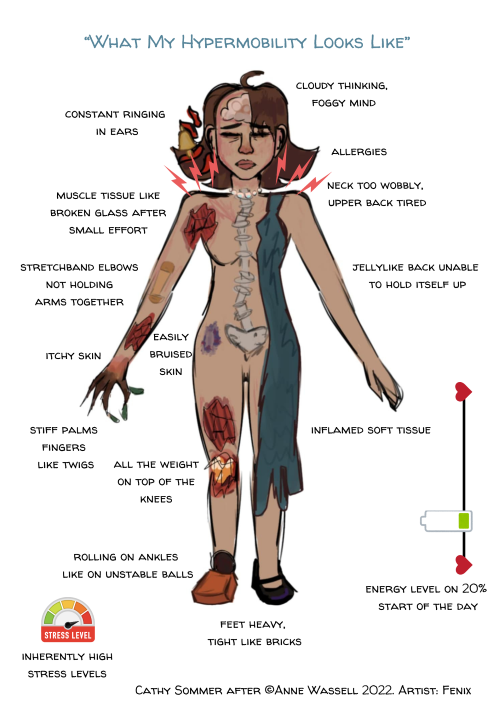
This illustration of anguish, exhaustion, and discomfort was created by Fenix, a gifted 14-year-old Estonian artist, who brought my experience from my mind into reality. The unanticipated outcome of this project has been the emotions that accompany taking off a lifelong mask: being seen with clarity and honesty has brought acceptance and joy without descending into victimhood. Self-empowerment comes from understanding.
Learning about trauma and its impact on the nervous system has been immensely important too. It’s no wonder the cause of the symptoms stays unclear: hypermobility, trauma, and nervous system sensitivity intertwine so subtly that they rarely point in one obvious direction.
When we are not heard, we learn to mask our symptoms. This serves the purpose of ‘looking normal’ and fitting in, but it also means that we are continuing to suffer instead of working on a solution. My sense of self has only grown stronger during the short months spent working on this picture, which has also helped me come up with fresh ideas for solutions. What would your picture of symptoms look like? Perhaps having your own image would serve you in a similar way.
Hypermobile Reality
For me, hypermobility shows up in small, daily tasks: cutting vegetables tires my arms, walking drains me, grocery bags stretch my elbows, and certain textures feel unbearable. Many of my clients describe similar patterns - not dramatic injuries, but a constant background struggle. These experiences often come not from weakness, but from a nervous system working overtime to create stability where connective tissue cannot.
I no longer feel that awful. The image attached appears to represent a phase in my recovery process, possibly the most challenging phase in terms of nervous system dysregulation. I like to keep it like that on paper, so that my own fluid, flexible and elastic self can continue to be readily changeable with the awareness and tools I’ve developed for myself. My elasticity is beginning to be balanced enough to serve me without leaving me feeling boundless and open.
The Role of Connective Tissue
Much of hypermobility’s confusion comes from the structure at the root of it all: connective tissue — also called fascia. It’s a body-wide network that gives shape, stability, and also houses nerve endings. When this tissue is extra elastic, the whole system has to work harder. This can create a wide mix of symptoms that seem unrelated, which is why people are often sent from specialist to specialist without a unifying explanation.
Fortunately, more people are becoming aware of the specifics, since 2017, the first research papers have been published. On my website, I've compiled a list of some of my favorite resources (read here). Finding a practitioner who can help you on your journey to a better quality of life is, in my opinion, just as important as knowing about the subject.
As practitioners of the Alexander Technique, we may be quite successful in helping people move from a state of discomfort to one that is more balanced, grounded, and connected. What really makes a difference is our comprehensive understanding of the human body-mind.
Hope for Change for the Better
Living with hypermobility can feel confusing until the pieces start to fit together. Understanding your body - its connective tissue, its sensitivities and its patterns - can bring enormous relief. Many people discover that with awareness and small adjustments, their system becomes calmer and more coordinated.
If any part of this feels familiar, you’re not alone. There is a name for these experiences, and there are ways to navigate them with less fear and more understanding. The journey often begins with one simple thing: noticing.
To pause, is what I always recommend as a life skill for someone who is hypermobile. Pause often. Pause to observe your experience. Then translate it into feelings and needs. From here, you can begin releasing stress from the mind and body, creating the space and balance that you truly need. Allow tension to let go, allow gravity to take your weight, and allow awareness to expand, staying present and intentionally contained. Notice above all that you are not letting go tension - it lets go once the conditions are appropriate and tension is no longer required.
I explore these themes in more depth in Part II. For now, you can explore some of the resources on my website. For private consultations, book a free 20-minute video call.